
Before The Excursion: The Governance Decisions That Should Already Be Made
By Révérien Uwacu, Founder & CEO, Rêve Solutions Consulting

A shipment of investigational product arrives at a regional depot. The data logger shows 14 hours above the labeled range during a customs hold. The depot quarantines the consignment and notifies the sponsor within the hour. So far, everything has worked exactly as designed.
Then it stops. The quality contact named in the study file left the company two months ago. Nobody is sure whether the decision belongs to sponsor QA, the contract manufacturer, or the qualified person at the depot. The stability data needed to make the call exists, but nobody agreed in advance what threshold would make the product usable. Eleven days later the product is released. It was viable the whole time. Two patients have missed a dosing window.
The excursion was an operational event. The 11 days were a governance failure.
I want to draw that line clearly because the industry has spent two decades getting better at preventing excursions and almost no time designing how to decide on them. In most programs the decision process is not designed at all. It is improvised, under pressure, by whoever is reachable.
Excursions Are Routine, Not Exceptional
Any governance model that treats temperature excursions as rare is built on a false premise. In Peli BioThermal's Biopharma Cold Chain Logistics Survey, nearly half of respondents (44.6%) reported multiple temperature excursions per year, 16% said excursions happened monthly, and 41% said their excursions exceeded 4 degrees.1 The same report quotes an IQVIA Institute estimate that the biopharma industry loses roughly $35 billion a year to failures in temperature-controlled logistics, a figure that includes lost product, clinical trial losses, replacement costs, and root cause investigation.1 Those numbers are from 2019, before real-time monitoring became common, so the trend has probably improved since. The order of magnitude has not changed.

Figure 1. Excursions are a recurring operating condition, not an exception to handle informally.
Set against those frequencies, a slow decision gets expensive fast. Tufts Center for the Study of Drug Development puts the value of one day of clinical development delay at around $800,000 in unrealized sales.2 A quarantine that runs 11 days instead of one is not a paperwork problem. It is a material one.
Four Decisions That Should Predate The First Shipment
Nearly every prolonged quarantine I have reviewed comes back to the same four questions being unanswered at the moment they were needed. None of them is hard. All of them are hard to answer at two in the morning across three time zones.
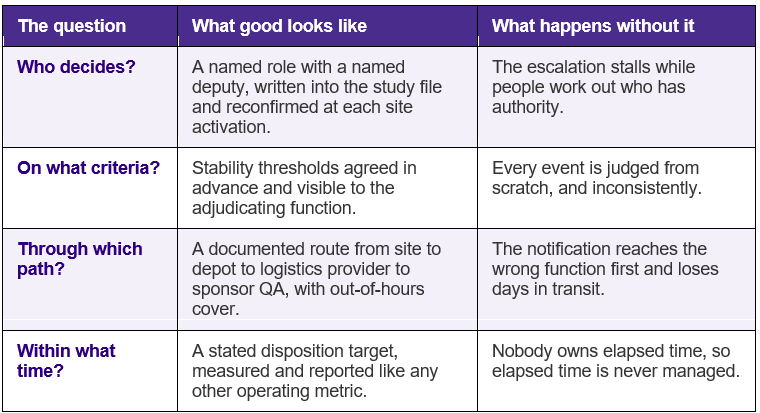
Figure 2. The four pre-decisions that determine how an excursion resolves.
ICH E6(R3) Has Raised The Bar
The revised Good Clinical Practice guideline reached Step 4 on January 6, 2025. The EMA applied it from July 23, 2025, the FDA published it as final guidance on September 9, 2025, and Health Canada brought it into force on April 1, 2026 with full compliance expected from October 1, 2026.3,4 Its position on delegated work is unambiguous. A sponsor may transfer tasks, duties, or functions but retains overall responsibility for them and must keep appropriate oversight of what has been transferred.3 It also states plainly that investigational products must be stored, shipped, handled, and disposed of in line with the product specification and the protocol.3 Put those provisions together and the disposition decision sits squarely inside the sponsor's accountability; however, many vendors stand between the manufacturing site and the patient.
What has changed in practice is what oversight means. Under a risk-based quality framework built on quality by design, sponsors are expected to identify their critical-to-quality factors early and design processes around them. Oversight becomes active, documented decision-making rather than passive receipt of vendor reports. An adjudication process that lives only in institutional memory does not meet that standard, and it will not hold up under inspection.
If clinical trial supply is a critical-to-quality system, and for any temperature-sensitive program it is, then the decision architecture around it has to be designed before activation, not reconstructed afterward.
Where The Gap Is Widest
Nowhere is this clearer than in the corridors I work in most. Across East and West Africa, the event that triggers a quarantine is more often a customs hold than a packaging failure, and the sponsor QA team is usually several time zones and a continent away from the depot holding the product. The Africa Clinical Research Network made the point well earlier this year: an excellent investigator cannot rescue a poorly sequenced import plan.8 The same is true of an excellent depot. When the disposition decision has not been designed in advance, a routine customs hold in Nairobi or Lagos does not cost a day. It costs a week, and the site is withdrawn before the product is. That is the failure mode I described in these pages in May, and governance is the layer that prevents it.9 It is also why sponsors who get this right in their hardest corridor tend to find it already fixed in their easiest ones.

Designing The Three Instruments
1. The disposition authority matrix
The authority matrix answers who decides, and it should be built to survive absence. For each decision type, name the accountable role, the deputy, and the escalation point above both. Note that this is roles, not people. People leave. Then test the matrix against the conditions excursions actually arrive in: a Friday evening delivery, a public holiday in the destination market, a depot running 6 hours ahead of the sponsor QA team.
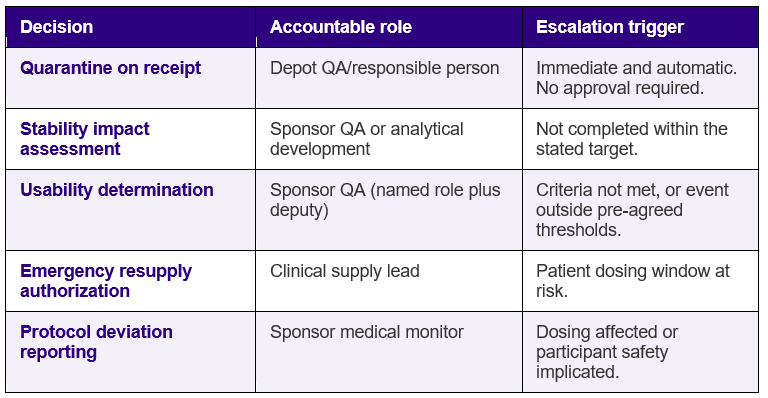
Figure 3. Illustrative disposition authority matrix. Roles should be reconfirmed at each site activation.
2. Pre-agreed adjudication criteria
The second instrument answers on what basis. Most temperature-sensitive products tolerate more deviation than their label suggests, and the supporting stability data usually exists. It simply is not in front of the person who needs it. A product labeled for 2 to 8 degrees C may hold at 9 to 15 degrees C for a defined number of minutes, and at 15 to 25 degrees C for a shorter window, before viability is in question. Giving quality teams predetermined, visible adjudication criteria produces a process that is faster and more defensible than case-by-case judgement.5
The stronger version of this is a cumulative stability budget, as described in PDA Technical Report 53: a defined total time the product may spend outside labeled conditions across its whole journey, drawn down leg by leg rather than assessed event by event.6 Programs that track a remaining stability budget can answer the usability question in minutes, because the calculation was agreed before the shipment moved.
3. A disposition time target
The third instrument answers how long. In my own work I set a mean time to disposition target, the elapsed time from excursion detection to a documented usability decision, and I treat it as a governance metric with the same standing as an enrollment or monitoring metric. The exact number matters less than the fact that one exists, is agreed with the sponsor before activation, and is reported against.
Two things make it work. It has to be measured from detection, not from notification, or the interval that most often does the damage is left out of the measurement. And it has to be reported, because a target nobody reports on is not a target. Programs that track disposition time find very quickly that most of the lost hours sit in one or two identifiable handoffs. That is exactly the information needed to fix them.
What Good Looks Like Before Activation
All of the following can be confirmed before a single kit ships. None of it needs new technology. All of it is inspectable.
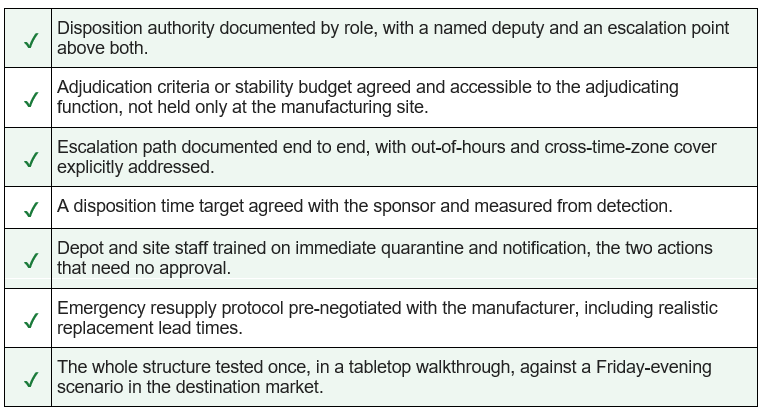
Figure 4. Pre-activation governance checklist for temperature-sensitive programs.
The tabletop walkthrough is the item most often skipped and the one that most reliably exposes gaps. It takes under an hour. It surfaces the missing deputy, the unreachable qualified person, and the criteria nobody can locate, while those things are still cheap to fix.
Conclusion
Temperature excursions will happen. Across a multiyear, multisite program with temperature-sensitive product they will happen repeatedly, and most will end with the product being usable. That is exactly why the decision architecture matters. Most of the cost is not spoiled product. It is viable product held too long while an organization works out who is allowed to say so.
ICH E6(R3) has made sponsor accountability for these systems explicit, and inspection expectations are following. But the stronger argument is operational, not regulatory. Governance designed in advance is what separates a 9-hour quarantine from a nine-day one. In a program with narrow dosing windows, it is also what separates a protocol deviation from a routine event that never reaches the medical monitor at all.
References:
- Peli BioThermal. 2019 Biopharma Cold Chain Logistics Survey. Minneapolis, July 2019. Excursion frequency findings (44.6% multiple excursions per year; 16% monthly; 41% exceeding four degrees) and the $35 billion annual loss estimate attributed to the IQVIA Institute for Human Data Science. Report: https://cdn2.hubspot.net/hubfs/4107558/general%20content/PEL1046_SurveyReport_v4a.pdf
- Smith Z, DiMasi JA, Getz KA. New Estimates on the Cost of a Delay Day in Drug Development. Therapeutic Innovation & Regulatory Science, 2024. DOI: 10.1007/s43441-024-00667-w
- International Council for Harmonisation. ICH E6(R3) Guideline for Good Clinical Practice, Step 4 Final Guideline, January 6, 2025. See sections 10.1 and 10.3 on transfer of activities and sponsor oversight, and section 11 on investigational product handling. https://database.ich.org/sites/default/files/ICH_E6%28R3%29_Step4_FinalGuideline_2025
_0106.pdf - Health Canada. Notice: Implementation of the ICH E6(R3) Guideline for Good Clinical Practice, in force April 1, 2026 with a six-month transition to October 1, 2026. https://www.canada.ca/en/health-canada/services/drugs-health-products/drug-products/announcements/implementation-ich-e6r3-guideline-notice.html. U.S. Food and Drug Administration, Federal Register notice of final guidance, September 9, 2025. European Medicines Agency, effective July 23, 2025.
- Applied Clinical Trials. Monitoring Temperature Control Throughout the IMP Supply Journey. On predetermined and visible adjudication criteria and product stability beyond labelled ranges. https://www.appliedclinicaltrialsonline.com/view/monitoring-temperature-control-throughout-imp-supply-journey
- Parenteral Drug Association. Technical Report No. 53: Guidance for Industry: Stability Testing to Support Distribution of New Drug Products. Bethesda, MD, 2011. Source of the stability budget concept as applied to end-to-end clinical supply.
- Uwacu R. CTS Africa Expansion Decision Framework. Rêve Solutions Consulting, 2025. Governance layer and disposition time targets derived from corridor and operator assessments across multiple markets.
- Africa Clinical Research Network. What Actually Delays Clinical Trials in Africa: A Systems-level Breakdown. May 4, 2026. https://acrnhealth.com/2026/05/04/what-actually-delays-clinical-trials-in-africa-a-systems-level-breakdown/
- Uwacu R. Expanding Clinical Trials in Africa Without Disruption. Clinical Supply Leader, May 7, 2026. https://www.clinicalsupplyleader.com/doc/expanding-clinical-trials-in-africa-without-disruption-0001
About The Author:
 Révérien Uwacu is the founder & CEO of Rêve Solutions Consulting, where he works on clinical trial supply chain strategy and governance design for complex and emerging market programs. He created the CCIM™ (Country-Contextualised IMP Management) framework and speaks regularly on the clinical trial supply circuit, including at the Clinical Trial Supply Forum and GCSG. He can be reached at info@reve-solutions.com.