
Clinical Trial Logistics Is No Longer A Support Function — It Is Quality Infrastructure
By Anastacia Edwards-Kurianova, MBA, Life Sciences Executive, AI Engineer, Global Quality Auditor

An investigational product can arrive on schedule and still be unavailable for use. Its temperature record may be incomplete, its allocation unresolved, or its receipt unconfirmed by the appropriate person. A delivery dashboard can show success while the trial remains exposed.
I use "quality infrastructure" to describe the connected physical capabilities, evidence, and decision rights that make protocol-compliant product use possible. Logistics belongs inside that infrastructure because it carries product condition and identity across organizational boundaries. Its performance affects what can be administered, when, and with what supporting evidence.
My experience building clinical supply operations has led me to one practical test: can the network demonstrate readiness to use the product when it is needed? Over the next decade, sponsors should organize logistics around that question, beginning during protocol design.
Design For The Treatment Opportunity
The ICH E8(R1) guideline places factors critical to study quality within study planning; E6(R3) embeds proportionate quality management in trial conduct.1 2 The operational implication is to test the supply model while visit schedules, country choices, packaging, and site capabilities can still change.
A narrow administration window, a short preparation period, or a limited site receiving schedule can determine network feasibility. Ask which constraint expires first, who can act before it expires, and what qualified alternative exists. Faster transport cannot resolve every constraint.
THE OPERATING MODEL
Connect Movement To Permission To Use
Build two connected records: the product's physical journey and the evidence supporting each change of status. Define common identifiers, event times, permitted transitions, and authoritative sources. A carrier's delivery event, a warehouse receipt, and confirmation of dispensing describe different things.
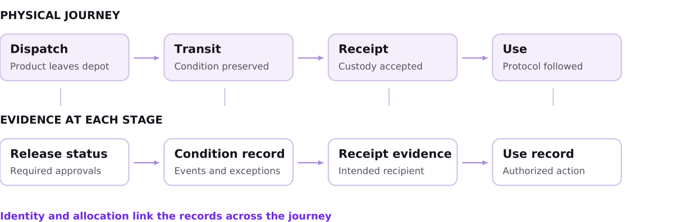
Figure 1. Physical progress and evidence must remain connected. Author's operating model; the evidence row shows examples, not a universal release sequence.
At each critical handoff, establish five conditions: correct identity and allocation; acceptable condition; required authorization; receiving and administration readiness; and retrievable evidence. Apply them proportionately. A conventional oral product and a patient-specific cell therapy do not need identical controls.
Treat data exchange as a contracted service: specify event definitions, acceptable latency, correction procedures, outage recovery, and subcontractor obligations. Resolve conflicting statuses through an agreed authority hierarchy. Copying every record into a central platform will not resolve a disagreement about what those records mean.
The FDA addresses investigator supervision, shipment integrity, receipt, and accountability in its guidance on decentralized elements.3 In the EU, E6(R3) Annex 2 is scheduled to take effect on Jan. 15, 2027; it also addresses direct shipment, privacy, and defined responsibilities.4 Distribution geography can change without transferring clinical accountability.
Put decision rights into agreements and operating procedures. Logistics coordinates and escalates; authorized quality personnel determine product disposition. Qualified Person certification, where required, and investigator or pharmacy decisions retain their respective owners. State who can impose a hold, who can remove it, and how the site receives the decision.
THREE ILLUSTRATIVE SCENARIOS
Test The Network Where Assumptions Fail
The scenarios below are hypothetical design tests, not reported client cases or observed outcomes.
A Refrigerated Shipment With Missing Evidence
A biologic reaches a site on time, but its logger file is unavailable. Missing data do not establish a temperature excursion or demonstrate acceptable conditions. The site follows the defined hold procedure while authorized quality personnel assess available evidence. The design test is whether the network can retrieve the record, identify affected units, and communicate disposition before the planned use. Build a qualified evidence-recovery process alongside the transport contingency.
An Autologous Therapy With An Identifier Mismatch
A cell therapy arrives within its specified conditions, but the patient identifier does not reconcile across records. Chain of custody records possession; chain of identity links the material to the intended patient. Neither replaces the other. The FDA's CAR T-cell guidance addresses documented tracking from collection through administration and patient and label checks.5 Test whether the mismatch creates a controlled hold across connected systems, including site workflows, rather than allowing one system's completed shipment to imply permission to administer.
A Home Delivery Without Confirmed Receipt
A courier scan records delivery, but the trial team cannot confirm receipt by the intended participant or designee. The protocol and applicable local requirements determine whether home delivery is appropriate. The operating model needs an agreed response for an absent recipient, uncertain storage, and return or replacement. Validate that response with the investigator and participant-facing team. A second shipment can create duplicate stock and accountability problems if the first remains unresolved.
Each exercise should end with observable evidence: the hold propagated, the right person decided, the recipient acknowledged the instruction, and the records reconciled. A tabletop discussion alone cannot demonstrate those capabilities.
If supply interruptions cluster by site or geography, involve clinical and statistical colleagues in assessing treatment exposure, protocol adherence, and missing data. The consequences depend on the study. A shipment deviation does not automatically invalidate results, but repeated disruption should inform study oversight rather than remaining inside a transport report.
THE METRICS AND ECONOMICS
Measure The Time Left To Recover
Transport speed is only one component of resilience. Decision latency can consume the time that a recovery plan needs. Define the remaining feasible window using the earliest relevant limit, such as qualified packaging duration, a product-specific handling limit, or the protocol's administration window.
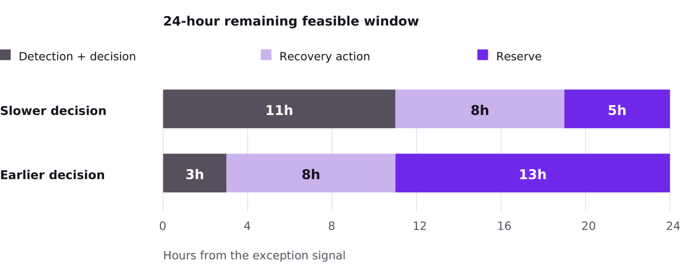
Figure 2. Illustrative calculation, not industry data. Both scenarios have a 24-hour remaining feasible window and an 8-hour recovery action. Activities are assumed sequential; all inputs are hypothetical.
In this model, reducing detection and authorized decision time from 11 hours to 3 preserves 8 additional hours of reserve. The calculation does not establish product acceptability, extend a validated limit, or prove an outcome improvement. It shows why evidence access and decision coverage deserve capacity planning.
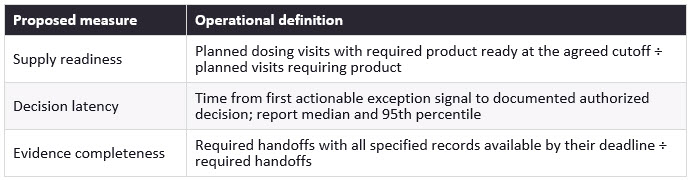
Proposed management measures; no industry benchmark or universal target is implied.
THE INVESTMENT DECISION
Fund Recovery That Can Be Activated
Set thresholds by product and trial, then segment results by country, site, and lane. Review tail latency as well as averages. An aggregate score can conceal the one lane with no workable recovery.
Budget for total supply failure exposure: replacement product, rescheduling, investigation, rework, and qualified backup capacity, alongside freight and inventory. ICH Q9(R1) connects quality risk management with product availability risks arising from quality and manufacturing issues.6 Redundancy needs testing for shared failure modes: two providers using the same airport or data platform may offer little independence.
The business case should distinguish buying capacity from maintaining a usable option. A backup depot has value only if its licenses, trained staff, inventory status, records, and activation time fit the trial. Test the option under realistic constraints before assigning it financial credit as a mitigation.
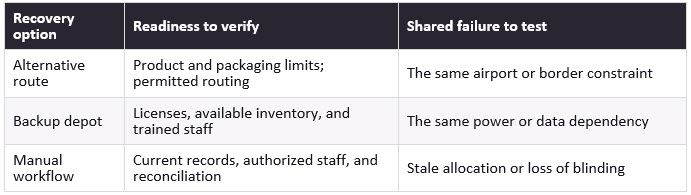
Illustrative qualification questions. A listed alternative is not automatically an executable contingency.

Figure 3. Selected regulatory milestones. Dates show publication or EU implementation as labeled, not a single global timetable.2 3 4 7 FDA, U.S. Food and Drug Administration; EMA, European Medicines Agency; EU, European Union; AI, artificial intelligence.
AI AND DECISION AUTHORITY
Give AI A Bounded Operational Role
AI can help assemble an exception record, estimate delay risk, and compare approved recovery options. Start with the decision it will support, the consequence of error, and the evidence needed to evaluate performance. The joint FDA-EMA good AI practice principles, issued in January 2026, emphasize context of use, data governance, risk-based evaluation, and life cycle management.7
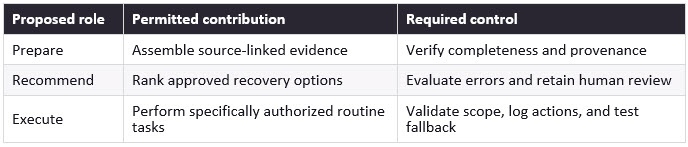
Author's governance model. Quality disposition and clinical decisions retain their authorized owners.
For a delay model, overall accuracy is insufficient. Challenge it with missing scans, unseen routes, identifier conflicts, and unusual disruption. Measure missed critical events and false alerts, including their effect on human workload. Define when the system must abstain and how staff continue when it is unavailable.
Keep deterministic identity and status controls where appropriate. A fluent explanation cannot repair incomplete source data. Record the input provenance, relevant model and configuration version, recommendation, authorized action, and rationale at a level proportionate to the risk. Protect blinding and restrict access to participant information.
Use a separate evaluation set that reflects the intended operating conditions. Reassess performance after material changes to models, prompts, interfaces, or routes; control production updates accordingly. Evaluate the complete workflow, including whether staff can recognize an unsupported recommendation. A technically functioning tool can still lead to a poor operational decision.
My forecast is that useful AI will increasingly preserve operational memory: which evidence supported a decision, which assumptions failed, and whether corrective action worked. That value depends on controlled data and review. Reusing historical workarounds without reassessment would institutionalize the defect.
THE OUTLOOK THROUGH 2035
Build The Network The Protocol Will Need
I expect the strongest clinical supply networks to develop along three horizons. These are conditional forecasts, not adoption estimates or announced regulatory requirements.
2026 To 2028 Make Evidence Interoperable
Sponsors should establish shared event definitions and reliable exchange between allocation, depot, transport, and quality systems. The early indicator is whether partners can reconcile a shipment's identity, condition, and status without manual reconstruction. Uncontrolled interfaces will limit progress even when individual platforms are capable.
2029 To 2031 Rehearse Change Before Activation
Qualified simulation should increasingly test enrollment shifts, protocol amendments, lane disruption, and backup capacity before execution. A useful model must expose assumptions and be checked against actual operating results. The test is whether simulations improve planning decisions; an elaborate digital twin with unreliable inputs adds little assurance.
2032 To 2035 Organize Around Product Constraints
Patient-specific products and tightly constrained handling windows could favor networks designed around collection, manufacturing, release, and administration together. Conventional products may still benefit from pooled inventory. I expect several operating models to coexist. Security, legal restrictions, site capacity, and the cost of maintaining qualified alternatives will determine their reach.
Start With One Trial In The Next 90 Days
During days 1 to 30, map one trial's critical handoffs and identify the earliest expiring constraints. During days 31 to 60, agree evidence requirements, decision owners, and escalation coverage with sites and partners. During days 61 to 90, run an observed disruption exercise, including a data outage, and measure time to a defensible decision. Scale only after the exercise exposes and resolves the material gaps.
The leadership decision is whether to fund and govern those capabilities as part of trial design. By 2035, I expect a network's strongest claim to reliability to be its demonstrated ability to preserve a treatment opportunity when conditions change. That capability must be designed, rehearsed, and evidenced before a participant depends on it.
References
- International Council for Harmonisation. E8(R1) General Considerations for Clinical Studies. 2021. Sections 3 and 7 on quality by design and critical-to-quality factors. Primary source
- International Council for Harmonisation. E6(R3) Guideline for Good Clinical Practice Principles and Annex 1. 2025. Sections 2.10, 3.10, and 3.15 on product management, quality management, and supply. Primary source
- U.S. Food and Drug Administration. Conducting Clinical Trials With Decentralized Elements. Final guidance, September 2024. Sections III.G and III.H on product suitability, packaging, and shipment. Primary source
- European Medicines Agency. ICH E6 Good Clinical Practice and E6(R3) Annex 2. Annex 2, sections 2.3 and 3.6. EMA lists Jan. 15, 2027, as its EU effective date. Implementation differs by jurisdiction. Primary source · Annex 2
- U.S. Food and Drug Administration. Considerations for the Development of Chimeric Antigen Receptor (CAR) T Cell Products. Final guidance, January 2024. Section IV.B on chain of identity, labeling, and tracking. Primary source
- International Council for Harmonisation. Q9(R1) Quality Risk Management. 2023. Section 6.1 on product availability risks arising from quality and manufacturing issues. Primary source
- U.S. Food and Drug Administration and European Medicines Agency. Guiding Principles of Good AI Practice in Drug Development. January 2026. Shared principles for AI used in evidence generation across the drug product life cycle. Primary source
Sources and regulatory status checked Oct. 31, 2026. The operating models, proposed measures, scenarios, and forecasts are the author's analysis.
About The Author
 Anastacia Edwards-Kurianova, MBA, is a life sciences executive, AI engineer, and global quality auditor. Her experience includes more than 20 years in clinical supply, quality, and operations; 300+ international clinical projects; 250+ GxP audits; and three GMP and good distribution practice (GDP) clinical supply facilities built from the ground up. She writes on quality systems, operational resilience, and responsible AI adoption.