
Cold Chain Excellence: Safeguarding Biologics, Cell Therapies, And Temperature-Sensitive Products In Complex Logistics
By Shanker Ojha
In the modern biopharmaceutical paradigm, where advanced therapeutics, messenger RNA (mRNA) platforms, and autologous or allogeneic cell therapies represent the leading edge of clinical medicine, cold chain integrity is no longer a passive transport function.1, 3 It serves as an active, critical extension of the drug manufacturing process itself.3, 6
Unlike small molecule chemical entities defined by structural stability, biological products rely on fragile tertiary and quaternary protein structures or live cellular viability to ensure clinical efficacy.5, 6 A single unvalidated thermal excursion during transit can trigger irreversible protein aggregation, denaturing, loss of functional potency, or catastrophic cell membrane lysis.1, 5
Despite advancements in logistics infrastructure, thermal breaches remain a primary root cause of high-value biopharmaceutical product loss during global distribution.1, 5 The financial and operational fallout extends far beyond the physical value of the destroyed inventory.1 For personalized autologous cellular therapies — where a patient’s own genetically modified T cells are in transit — a temperature-compromised shipment represents a life-threatening delay for a patient with no alternative treatment options.1, 6
To safeguard these therapies across volatile global networks, biopharmaceutical sponsors, quality managers, and logistics architects must abandon generic cold chain handling and transition toward a rigorous, data-validated, and risk-engineered thermal governance framework.2, 3 That framework influences decisions made long before a shipment leaves the warehouse, including packaging qualification, lane selection, depot strategy, and contingency planning for global studies.
Macro Data: Temperature Regimes And Molecular Risk Vectors
Maintaining compliance across cold chain operations requires strict adherence to defined thermal zones.1, 2 Each biological modality presents distinct degradation pathways when exposed to ambient temperature anomalies:5, 6
- Controlled Room Temperature ([CRT], 15 degrees C to 25 degrees C): Often mischaracterized as low-risk, CRT formulations face severe ambient fluctuations during tarmac delays, customs holds, or freight transfers.1, 3 Uncontrolled heat exposure accelerates chemical degradation, whereas sub-ambient drops induce drug precipitation or compromise primary container closure integrity.3, 6
- Refrigerated (2 degrees C to 8 degrees C): This is the standard regime for monoclonal antibodies (mAbs), recombinant proteins, and conventional vaccines.1, 5 The primary risk vector in this zone is accidental sub-zero freezing caused by direct contact with improperly conditioned gel packs or uncalibrated active cooling units, which instantly denatures protein structures.4, 5 Preventing these failures often depends less on the packaging itself than on how conditioning procedures, handling instructions, and carrier training are standardized across every distribution partner.
- Frozen/Deep Frozen (minus 20 degrees C to minus 80 degrees C): This is mandatory for viral vectors, enzyme replacement therapies, and specialized mRNA lipid nanoparticle (LNP) platforms.6 Key operational hazards include dry ice sublimation during customs clearance delays and solid-state degradation resulting from out-of-specification storage environments.1, 5
- Cryogenic (minus 150 degrees C to minus 196 degrees C): The strict baseline for live cellular therapies (e.g., CAR-T).1, 6 Utilizing liquid nitrogen (LN2) dry shippers, these systems require complete physical vapor-phase integrity to prevent ice recrystallization, cell membrane rupture, and total loss of viability.1, 5 Because replacement material may not exist for autologous therapies, every transfer point and transport handoff becomes a critical point rather than simply another logistics event.
High-Resilience Cold Chain Implementation Blueprint
Strategy A: Deploy Real-Time Telemetry And Predictive Thermal Monitoring
Relying on passive post-transit USB temperature loggers creates a post-mortem quality environment where excursions are identified only after the payload has already degraded.2 High-performing cold chain networks utilize active Internet of Things (IoT) sensor arrays to monitor shipments in real time.2, 3
- Continuous Data Acquisition: Multi-sensor IoT devices stream real-time payload temperature, ambient external temperature, GPS location, barometric pressure, light exposure (indicating unauthorized opening), and tilt/shock orientation.2
- Proactive Control-Tower Intervention: Live telemetry feeds directly into central logistics control towers.2 If a shipment experiences sun exposure on an airport tarmac and internal payload temperatures drift toward upper action limits, automated alerts trigger local carrier intervention to relocate the cargo to temperature-controlled storage before a compliance breach occurs.2, 3
Real-time visibility also provides supply teams with the documentation needed to support excursion assessments, release decisions, and deviation investigations when unexpected events occur.
Strategy B: Transition To Advanced Phase-Change Materials And Active LN2 Shippers
Traditional single-use expanded polystyrene (EPS) packaging paired with water-based gel packs provides narrow protection windows and exhibits extreme vulnerability to seasonal ambient shifts.4, 5
- Advanced PCM Shippers: Engineered phase-change materials (PCM) that freeze or melt at specific transition thresholds (4 degrees C, 22 degrees C, minus 21 degrees C) provide thermal stability regardless of external ambient spikes.4, 5
- Active Cryogenic Dry Shippers: For live cell therapies, deploying dynamic, high-vacuum-insulated LN2 dry vapor shippers maintains continuous temperatures below minus 150 degrees C for 10 to 14 days without requiring external power or LN2 recharges during transit.1, 5
Selecting cold chain strategies is rarely a packaging decision alone; it requires balancing product stability, lane risk, regulatory requirements, study timelines, and operational feasibility across the entire distribution network.
Strategy C: Executing Dynamic Lane Qualification And Ambient Profiling
Placing a high-value biological product into an unvalidated transport lane constitutes a severe quality system vulnerability.3, 6 Comprehensive route risk assessment requires rigorous qualification protocols.2, 3
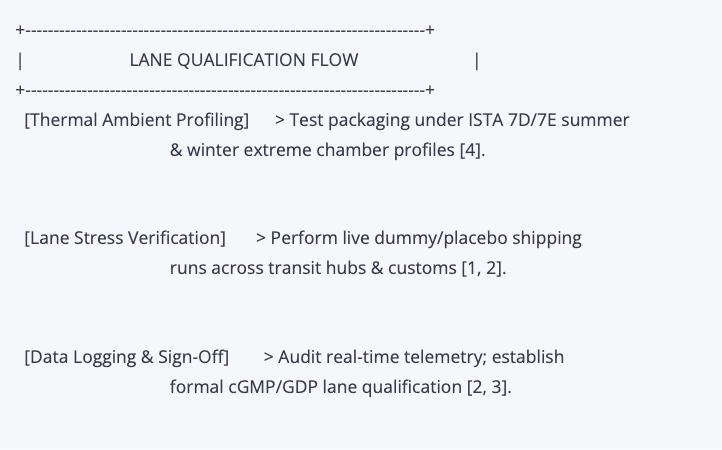
- Thermal Ambient Profiling: Packaging designs must be qualified against worst-case seasonal profiles (e.g., ISTA 7D/7E standards) using calibrated environmental simulation chambers.4
- Lane Verification Runs: Executing dummy or placebo shipments along active trade corridors — including transfer hubs, customs clearing points, and last-mile delivery vectors — verifies performance under real-world operational stress.1, 2, 3
- These qualification activities become increasingly important as studies expand into new countries where customs practices, infrastructure, and transit times differ significantly from previously validated routes.

The Cold Chain Operational Resilience Framework
To ensure audit readiness, eliminate quality leakage points, and optimize distribution workflows, quality assurance and logistics teams must manage cold chain operations through quantitative metrics:2, 3, 6
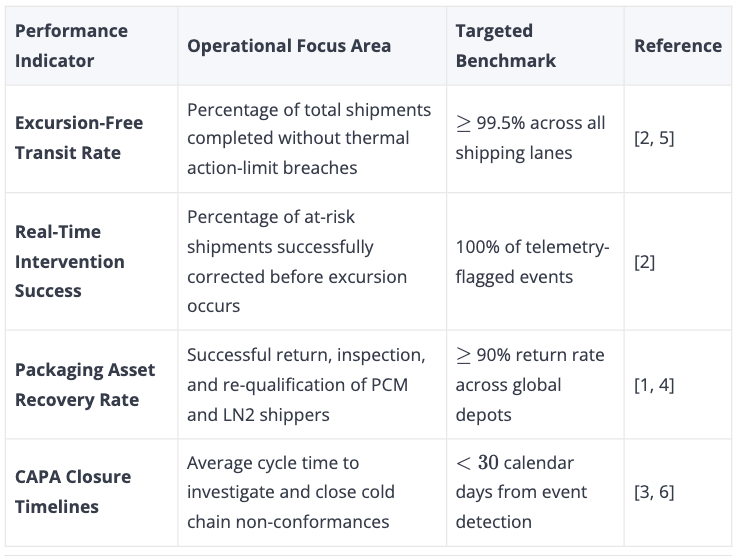
These metrics are most valuable when reviewed together rather than in isolation. A low excursion rate may still conceal recurring lane instability, delayed interventions, or process weaknesses that only become apparent through trend analysis.
Summary: Ensuring Product Integrity At The Patient Edge
Managing cold chain logistics for biological therapies demands zero tolerance for operational ambiguity.3, 6 Protecting these sensitive products requires three foundational pillars:2, 5
- Integrate End-to-End Validation: Validate every thermal packaging system, transport lane, and storage node under cGMP and Good Distribution Practice (GDP) guidelines.2, 3, 6
- Mandate Real-Time Visibility: Shift from historical data logging to active, IoT-driven telemetry to detect and intercept thermal threats before product quality is compromised.2
- Standardize Risk-Based SOPs: Establish clear preapproved action protocols for handling transit delays, customs holds, power outages, and equipment failures across all site and carrier touchpoints.1, 2, 3
By embedding data-validated thermal packaging, real-time telemetry, and proactive quality governance into global supply networks, biopharmaceutical organizations can guarantee that every dose arrives fully potent, fully compliant, and safe for the patient.3, 6
References:
- World Health Organization. Model Guidance for the Storage and Transport of Time-and Temperature-Sensitive Pharmaceutical Products. WHO Technical Report Series, No. 961, Annex 9, 2011.
- European Commission. Guidelines on Good Distribution Practice of Medicinal Products for Human Use (2013/C 343/01). Official Journal of the European Union, 2013.
- U.S. Food and Drug Administration. 21 CFR Part 211: Current Good Manufacturing Practice for Finished Pharmaceuticals. Code of Federal Regulations, 2025.
- International Safe Transit Association. ISTA Standard 7D: Thermal Performance Testing for Packaging. ISTA Guidelines, 2023.
- Parenteral Drug Association. Technical Report No. 39 (Revised 2021): Guidance for Temperature-Controlled Medicinal Products: Maintaining the Quality of Temperature-Sensitive Medicinal Products Through the Transportation Environment. PDA Journal of Pharmaceutical Science and Technology, 2021.
- International Council for Harmonisation. ICH Topic Q5C: Quality of Biotechnological Products: Stability Testing of Biotechnological/Biological Products. European Medicines Agency (EMA), 2022.
About The Author:
 Shanker Ojha is a biopharmaceutical validation professional with over a decade of hands-on experience managing complex commissioning, qualification, and validation (CQV) cycles, QMS, and GMP compliance. His career is built on the shop floor, bridging the gap between technical engineering and time-sensitive manufacturing operations, including leading major process validation projects for biologics.
Having worked directly inside manufacturing hubs, Ojha knows firsthand how clinical supply lines stall when validation is treated as a retrospective paperwork drill. His focus is on synchronizing computer system validation (CSV) with physical assets and using risk-based frameworks to compress timelines. Shanker advocates for floor-level psychological safety, ensuring operators can flag technical anomalies instantly to resolve issues in real time.