
Managing Customs, Import/Export Requirements, And Cross-Border Logistics Challenges
By Shanker Ojha

In global biopharmaceutical clinical supply chains, cross-border logistics is frequently the most unpredictable operational bottleneck.1,2 While cold chain technology has advanced significantly, technical packaging cannot protect a product if cargo remains stranded at a port of entry due to incomplete customs documentation, tariff misclassifications, or unaligned regulatory approvals.2,3
Unlike commercial general cargo, investigational medicinal products (IMPs), human biological specimens, and advanced therapeutic medicinal products (ATMPs) carry strict stability windows.1,5 A delay of 48 to 72 hours at a border point can lead to thermal packaging exhaustion, resulting in product degradation, unblinding risks, or complete trial discontinuation.1,5
To mitigate these risks, biopharmaceutical sponsors and global trade operations must move away from reactive customs clearance routines. Instead, organizations must implement proactive, data-validated import and export frameworks that integrate regulatory change control directly into clinical supply chain planning.2,3
Macro Data: Border Friction Points And Regulatory Vulnerabilities
Global distribution networks face systemic hurdles when moving temperature-sensitive biological goods across international borders.1,2 Primary operational friction points include:
- Customs Valuation Discrepancies: Investigational drugs lack established commercial market values, often leading customs officials to question nominal invoice values. Inappropriate valuation assessments can trigger prolonged administrative holds or unexpected duty assessments.2,3
- Import Licensing Delays: Many regulatory jurisdictions require trial-specific import permits prior to shipment dispatch. Dispatching cargo before receiving full regulatory clearance frequently results in quarantine at destination air hubs.2,3
- Biological Material Clearance Protocols: Border authorities inspect biological shipments for biosecurity compliance, requiring detailed documentation regarding species origin, viral safety clearance, and non-contagious status.1,6 Missing veterinary or biosafety certificates leads to immediate customs holds.2,6
- Dual-Use Export Controls: Specialized bioprocessing equipment, high-grade bioreactors, and viral vectors can fall under international dual-use export control regimes, requiring specialized export licenses before leaving the country of origin.3,6
High-Resilience Cross-Border Implementation Blueprint
Strategy A: Preclearance Validation And Digital Documentation Synchronization
Relying on physical paper invoices attached to shipping containers increases the risk of document loss or administrative errors at destination hubs.2 Advanced trade logistics frameworks utilize electronic preclearance workflows.2,3
- Digital Document Pre-Filing: Air waybills, pro-forma invoices, certificates of analysis (CoA), import licenses, and packing lists are transmitted digitally to local customs brokers prior to physical flight departure.2,3
- Automated Tariff Classification: Utilizing standardized Harmonized System (HS) codes tailored specifically for biologics, clinical trial kits, and active pharmaceutical ingredients prevents reclassification holds by border officers.2,3
Strategy B: Establish In-Country Regulatory Brokers And Importer Of Record (IOR) Networks
A primary reason for customs rejections is the lack of a legal entity to act as the Importer of Record (IOR) or Exporter of Record (EOR) in the destination country.2
- IOR/EOR Designation: Establishing clear legal agreements with local qualified entities ensures that tax liabilities, regulatory declarations, and customs queries are handled immediately upon cargo arrival.2,3
- Customs Broker Integration: Partnering with specialized healthcare customs brokers ensures direct communication with airport border posts, enabling priority handling for temperature-sensitive air freight.2

Strategy C: Execute Route Risk Assessment And Border Delay Contingencies
Placing a clinical shipment into a cross-border transport lane without evaluating local customs clearance speeds introduces unnecessary quality risks.1,2 Comprehensive logistics planning requires validated contingency procedures:1,3
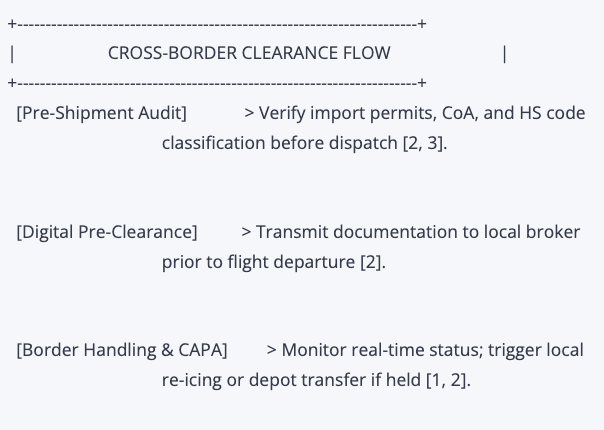
- Pre-Shipment Documentation Audits: Quality assurance and trade compliance teams must review all shipping papers against destination country import guides prior to releasing cargo from the central depot.2,3
- On-Site Re-Icing Protocols: Establish preapproved service level agreements (SLAs) with airport ground handling stations to re-ice dry ice shippers or recharge phase-change materials if customs clearance exceeds 24 hours.1,5
Cross-Border Operational Resilience Framework
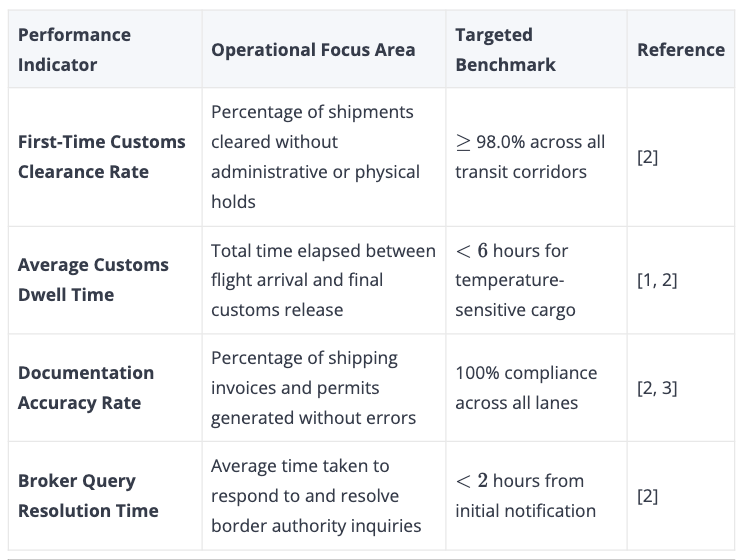
To track import and export efficiency, prevent regulatory holds, and maintain inspection readiness, global supply chain teams should monitor key trade performance indicators.2,3
Summary: Navigating Global Trade Complexity
Managing cross-border logistics for biopharmaceutical products requires strict operational discipline and advance regulatory alignment.2,3 Protecting global supply lines requires three core principles:2
- Synchronize Regulatory and Supply Operations: Ensure import licenses, clinical trial approvals, and customs documentation are fully aligned before executing physical shipments.2,3
- Standardize Digital Preclearance: Leverage electronic data interchange (EDI) to submit customs declarations prior to cargo departure, minimizing tarmac dwell times.2
- Embed Local Contingencies: Partner with specialized healthcare brokers and airport ground services to provide immediate intervention, re-icing, and temperature-controlled storage during unexpected border delays.1,2
By integrating proactive trade compliance, digital preclearance workflows, and robust local broker networks, biopharmaceutical companies can ensure seamless global product movement, protecting both clinical timelines and patient safety.2,3
References:
- World Health Organization. Model Guidance for the Storage and Transport of Time- and Temperature-Sensitive Pharmaceutical Products. WHO Technical Report Series, No. 961, Annex 9, 2011.
- European Commission. Guidelines on Good Distribution Practice of Medicinal Products for Human Use (2013/C 343/01). Official Journal of the European Union, 2013.
- U.S. Food and Drug Administration. 21 CFR Part 211: Current Good Manufacturing Practice for Finished Pharmaceuticals. Code of Federal Regulations, 2025.
- International Safe Transit Association. ISTA Standard 7D: Thermal Performance Testing for Packaging. ISTA Guidelines, 2023.
- Parenteral Drug Association. Technical Report No. 39 (Revised 2021): Guidance for Temperature-Controlled Medicinal Products: Maintaining the Quality of Temperature-Sensitive Medicinal Products Through the Transportation Environment. PDA Journal of Pharmaceutical Science and Technology, 2021.
- International Council for Harmonisation. ICH Topic Q5C: Quality of Biotechnological Products: Stability Testing of Biotechnological/Biological Products. European Medicines Agency (EMA), 2022.
About The Author:
 Shanker Ojha is a biopharmaceutical validation professional with over a decade of hands-on experience managing complex commissioning, qualification, and validation (CQV) cycles, QMS, and GMP compliance. His career is built on the shop floor, bridging the gap between technical engineering and time-sensitive manufacturing operations, including leading major process validation projects for biologics.
Having worked directly inside manufacturing hubs, Ojha knows firsthand how clinical supply lines stall when validation is treated as a retrospective paperwork drill. His focus is on synchronizing computer system validation (CSV) with physical assets and using risk-based frameworks to compress timelines. Shanker advocates for floor-level psychological safety, ensuring operators can flag technical anomalies instantly to resolve issues in real time.