
Rethinking The Clinical Supply Chain: Practical Strategies For Slashing Trial Waste
By Shanker Ojha

It is an uncomfortable truth in clinical development that supply issues are often locked into place long before the first patient gets randomized. Historically, clinical operations teams have simply accepted massive product overages as a cost of doing business, leading to an environment where 25% to 50% of all manufactured, packaged, and distributed investigational medicinal products (IMPs) end up being destroyed.
With modern global supply chains under constant pressure from material shortages and volatile transport costs, this level of waste is no longer just an environmental issue — it is a glaring operational risk. Today's clinical supply managers are tasked with making trials faster and more resilient while working under tighter budgets. To move the needle, modern sponsors need to shift focus toward targeted, data-backed sustainability changes that protect study continuity while delivering clear bottom-line savings.
1. Risk-Based Supply Optimization And Predictive Analytics
Leaning on generic bulk buffer stocks to manage unpredictable patient enrollment and localized dropouts inevitably drives up trial overages.
- The Strategy: Move away from static spreadsheets and adopt advanced clinical supply forecasting models to simulate trial progression. By feeding real-time enrollment dynamics into optimization tools, supply managers can continually adjust site delivery thresholds and package sizes to match actual study needs.
- Measurable Impact: Brings down planned drug requirement overages by 20% to 60%. This shift prevents significant costs by scaling back the overproduction of expensive comparators and delicate biological materials before they are ever shipped.
2. Demand-Led Just-In-Time (JIT) Packaging And Labeling
Preprinting country-specific labels and pushing large batches of inventory to regional depots creates a massive liability, especially when protocol shifts disrupt local recruitment timelines.
- The Strategy: Transition to a demand-driven JIT model where clinical supplies are held at central depots as unlabeled bright stock. Final kitting and labeling are only executed after a confirmed site or depot order is triggered through the interactive response technology (IRT) system.
- Measurable Impact: Eliminates the traditional risk of front-loading finished product. By processing only what patients actively require, teams significantly reduce raw API consumption and drastically cut down on the volume of hazardous chemical waste slated for destruction when the trial wraps up.
3. Circular Logistics: Reusable Cold Chain Ecosystems
Temperature-controlled distribution networks have long relied on single-use insulated packaging and disposable data loggers that go straight to the landfill after a single delivery.
- The Strategy: Partner with logistics providers to establish a closed-loop system using high-performance, phase-change reusable shipper boxes paired with multiuse IoT temperature tracking hardware.
- Measurable Impact: Adopting a return-and-reuse asset model drops packaging waste volumes by 80% or more over a trial's lifespan. At the same time, switching to lighter, optimized primary container footprints allows sponsors to maximize payload density and lock in lower freight rates.

4. Maximizing Site Resource Efficiency: Digital Workflows And Strategic Donation
Even with tight forecasting parameters, local trial sites frequently end up with a surplus of unused ancillary supplies, hardware, and medical devices that take up valuable storage and require manual tracking for disposal. Furthermore, paper-reliant administrative steps create an unnecessarily heavy carbon trail.
- The Strategy: Deploy fully integrated digital trial tools — like eConsent, eCOA, and digitized trial master files (eTMFs) — to remove paper waste entirely. Simultaneously, incorporate structured, compliant supply donation protocols (such as the industry-vetted Kits4Life framework) directly into standard study closeout procedures.
- Measurable Impact: Saves thousands of printed physical records per site while routing clean unused ancillaries (like gloves, masks, and syringes) and site devices (like smartphones or tablets) to international humanitarian programs. This keeps valuable assets out of incinerators and simplifies final site reconciliation workflows.
Quantifying Success: The Clinical Sustainability Dashboard
To get real traction with executive leadership, sustainability cannot remain a theory. Teams must track clear, auditable KPIs to demonstrate financial and operational progress.
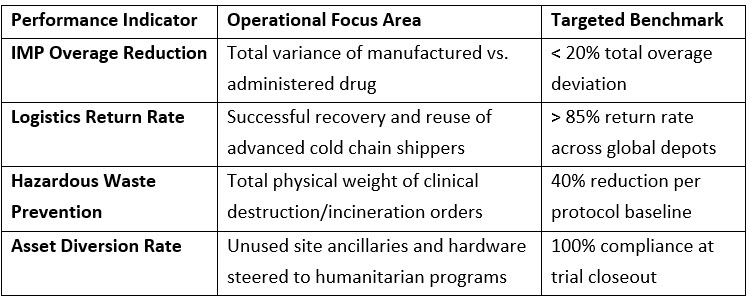
Clinical trial sustainability should not be treated as a stand-alone initiative. The same practices that reduce waste — more accurate forecasting, demand-driven packaging, reusable logistics assets, and disciplined inventory management — also strengthen supply resilience and improve operational performance. As sponsors face increasing cost pressures and supply chain complexity, integrating these strategies into routine clinical supply planning can help deliver both financial and operational value.
References & Further Reading:
- Framework for Sustainable Clinical Trials and Scope 3 Supply Chain Reductions. Journal of Pharmaceutical Sciences & Clinical Operations, 2024.
- Just-In-Time (JIT) Manufacturing Models and Material Conservation in International Multi-Center Protocols. International Clinical Supply & Logistics Review, 2025.
- Environmental Footprint of Cold-Chain Management: Shifting from Single-Use Systems to Circular Asset Return. Green Logistics Quarterly, 2024.
- Kits4Life Initiative: A Standardized Protocol Framework for Cross-Company Secondary Utilization of Trial Site Ancillary Supplies. Global Health & Trial Infrastructure Briefings, 2023.
About The Author:
 Shanker Ojha is a biopharmaceutical validation professional with over a decade of hands-on experience managing complex commissioning, qualification, and validation (CQV) cycles, QMS, and GMP compliance. His career is built on the shop floor, bridging the gap between technical engineering and time-sensitive manufacturing operations, including leading major process validation projects for biologics.
Having worked directly inside manufacturing hubs, Ojha knows firsthand how clinical supply lines stall when validation is treated as a retrospective paperwork drill. His focus is on synchronizing computer system validation (CSV) with physical assets and using risk-based frameworks to compress timelines. Shanker advocates for floor-level psychological safety, ensuring operators can flag technical anomalies instantly to resolve issues in real time.