
The Fragility Of Efficiency: Why Global Clinical Supply Chains Fail In An Era Of Geopolitical Fragmentation
By Shanker Ojha, Biopharmaceutical Validation Professional

It is a sobering reality in clinical development that supply failures are routinely locked into place years before the first protocol is written or the first patient is randomized.1 Historically, clinical operations teams treated massive product overages as a standard cost of doing business.1 This legacy mindset created an operational environment where 25% to 50% of all manufactured, packaged, and distributed investigational medicinal products (IMPs) end up in an incinerator.1
When maritime corridors were stable and trade policies were predictable, this level of waste was hidden under the line item of “risk mitigation.”1 Today, that luxury is dead.1
Between volatile tariff structures, the fracturing of traditional trade blocs, and critical maritime and air transport chokepoints, the hyper-optimized, cost-focused clinical logistics framework has broken. Clinical supplies cannot be placed on a back-order list without immense consequences. A single missed delivery or a compromised cold chain shipment directly threatens patient safety, corrupts clinical data continuity, and threatens multimillion-dollar trial timelines.
To protect clinical portfolios in an era of global fragmentation, sponsors must abandon passive, efficiency-first supply configurations and move toward an aggressive, data validated, and structurally redundant framework.1
Macro Data: Sourcing And Regulatory Vulnerabilities
The modern clinical trial landscape operates on an inherently unstable baseline. Sourcing and regulatory structures reveal sharp operational exposures:
- Upstream Concentration Risk: Only approximately 28% of active pharmaceutical ingredient (API) facilities serving critical Western clinical programs are located domestically. The remaining 72% are heavily concentrated in centralized production corridors across the Asia-Pacific region, exposing global clinical timelines to unilateral export controls or regional regulatory gridlocks.
- The Sunk Capital of Structural Over-Allocation: Traditional protocol designs are highly inefficient. On average, nearly 70% of synthesized IMPs deployed to global multicenter trials go completely unused and reach expiration, heavily draining raw material reserves and spiking clinical budgets.1
- The Regulatory Change Control Trap: Swapping an upstream supplier or a secondary packaging site mid-trial is a sluggish operational maneuver. Under frameworks like the FDA’s 21 CFR § 312, significant modifications to a manufacturing network require formal IND notifications, introducing months of supplier qualification and validation delays at the precise moment a trial requires immediate operational flexibility.
Recent Geopolitical Shockwaves
Logistics disruptions across major trade lanes have conclusively proved that structural stability is no longer a safe baseline assumption. Recent geopolitical friction points highlight the exact risks sponsors must insulate against:
The Maritime Detour (the Suez and Bab El-Mandeb Disruptions)
Protracted security escalations along critical maritime trade arteries forced shipping lines to bypass primary canals entirely, routing cargo around Africa’s Cape of Good Hope. This added a rigid 10 to 14 days to standard transit windows. For clinical supply managers dealing with tight shelf-life boundaries or time-sensitive placebos, these extended durations drastically narrowed the margin for error, spiked demurrage fees, and pushed traditional passive insulation systems to their absolute failure thresholds.
Air Freight Capacity Crunches
Regional airspace closures have triggered sudden severe drops in commercial air cargo capacity. Because approximately 4% of all global air freight consists of advanced pharmaceuticals, bioprocess components, and biological materials, these sudden airspace restrictions caused spot freight rates to surge unpredictably. Sponsors were forced to contend with bidding wars for temperature-controlled pallet space, causing significant budget variances and unexpected warehouse backlogs.
High-Resilience Implementation Blueprint
Strategy A: Deploy Supply Chain Digital Twins and Predictive Routing
Traditional forecasting methods that rely on static historical spreadsheets fail to capture the reality of live border closures or sudden custom holds.1 High-performing sponsors are replacing these models with supply chain digital twins — dynamic virtual replicas of the entire end-to-end trial infrastructure.1
By feeding real-time enrollment dynamics, carrier capacity, and shipping lane risk profiles into predictive models, supply managers can simulate trial progression and continually adjust site delivery thresholds.1
- Operational Outcome: This data-driven agility drops planned drug requirement overages by 20% to 60%.1 By identifying bottlenecks before they manifest, sponsors can scale back the overproduction of expensive comparators and delicate biological materials before they are ever exposed to a vulnerable transit lane.1

Strategy B: Transition to Demand-Driven “Bright Stocking”
Preprinting country-specific labels and pushing massive batches of finished inventory out to regional depots leaves inventory exposed to sudden customs holds, trade disputes, or regulatory shifts.1
The high-yield alternative is an international, multicenter Just-In-Time (JIT) manufacturing and material conservation model.2 Clinical supplies are held at central, secure hubs as completely unlabeled bright stock.1 Final kitting, language translation allocation, and packaging serialization are executed only after an interactive response technology (IRT) system triggers a confirmed order based on live site demand or active patient randomization.1
- Operational Outcome: This strategy completely eliminates the risk of front loading finished products.1 It significantly reduces raw API consumption across international protocols.2 If a specific trade lane collapses, the unallocated drug product remains fully fluid and can be instantly redirected to an active accessible global region without incurring heavy repackaging fees or triggering regulatory change control traps.1
Strategy C: Closed-Loop Reusable Logistics
Material shortages frequently strike petrochemical-derived single-use packaging components, causing extreme cost volatility for clinical logistics.1 Sponsors should partner with logistics providers to establish a closed-loop system using high-performance, phase-change reusable shipper boxes paired with multiuse IoT temperature tracking hardware.3
Case Study: Slashing Clinical Waste Via Circular Closed Loops
Context: A multinational multicenter protocol faced extreme freight cost volatility and a critical shortage of standard insulated shipping materials due to regional industrial disruptions.1
Action: The operational team completely abandoned single-use packaging, moving to an asset-recovery model featuring heavy-duty phase-change shipper boxes and reusable IoT monitoring hardware.3
Result: Adopting this return-and-reuse asset model dropped packaging waste volumes by over 80% across the study life cycle.3 By maintaining a predictable closed return loop between global depots, the sponsor completely insulated the study from external packaging material shortages, while locking in lower freight rates through optimized payload densities.3
The Resilience Metric Framework
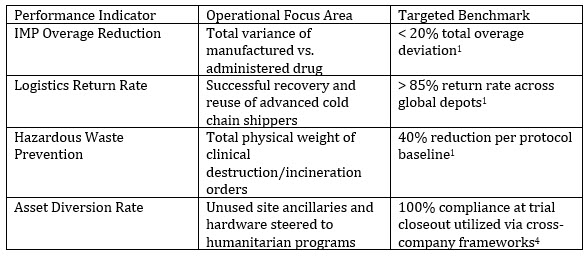
To secure internal funding and align executive leadership, clinical resilience cannot remain a theoretical concept; it must be managed through clear, auditable KPIs.1
Summary: Designing For Antifragility
Optimizing supply lines strictly for low baseline cost is an obsolete strategy. Building a truly disruptor-proof clinical trial supply chain requires treating adaptability as a concrete budget line item rather than a passive hope.1
- Map Hidden Dependencies: Conduct deep risk-mapping across all contract manufacturing organizations (CMOs) to uncover hidden single-source tier 2 or tier 3 material concentrations.
- Bake Redundant Sites into Protocols: Utilize an adaptive material conservation model natively at the initial IND submission stage.2 Prequalifying secondary and tertiary packaging sites from day one allows organizations to instantly pivot production locations without waiting for retrospective regulatory paperwork cycles.
- Unify the Data Ecosystem and Closeout Workflows: Ensure that clinical operations and supply logistics share a unified data set.1 When real-time patient enrollment fluctuates or transit lanes degrade, the system must automatically adjust distribution windows to protect the patient.1 Concurrently, standardize secondary utilization frameworks during site reconciliation to cleanly reroute unused ancillary trial supplies directly to international humanitarian programs rather than landfills.4
The future of clinical development belongs to those who design their clinical supply chains to be as robust and adaptive as the science behind the medicines they deliver.1
References
- Framework for Sustainable Clinical Trials and Scope 3 Supply Chain Reductions. Journal of Pharmaceutical Sciences & Clinical Operations, 2024.
- Just-In-Time (JIT) Manufacturing Models and Material Conservation in International Multi Center Protocols. International Clinical Supply & Logistics Review, 2025.
- Environmental Footprint of Cold-Chain Management: Shifting from Single-Use Systems to Circular Asset Return. Green Logistics Quarterly, 2024.
- Kits4Life Initiative: A Standardized Protocol Framework for Cross-Company Secondary Utilization of Trial Site Ancillary Supplies. Global Health & Trial Infrastructure Briefings, 2023.
About The Author:
 Shanker Ojha is a biopharmaceutical validation professional with over a decade of hands-on experience managing complex commissioning, qualification, and validation (CQV) cycles, QMS, and GMP compliance. His career is built on the shop floor, bridging the gap between technical engineering and time-sensitive manufacturing operations, including leading major process validation projects for biologics. Having worked directly inside manufacturing hubs, Ojha knows firsthand how clinical supply lines stall when validation is treated as a retrospective paperwork drill. His focus is on synchronizing computer system validation (CSV) with physical assets and using risk-based frameworks to compress timelines. Shanker advocates for floor-level psychological safety, ensuring operators can flag technical anomalies instantly to resolve issues in real time.