
The Handoff Problem: Where Clinical Supply Execution Actually Breaks
By Rakibou Ouro-Djobo

Clinical supply organizations are built around functions. Trials run through handoffs. The most dangerous failures often emerge in the space between the two.
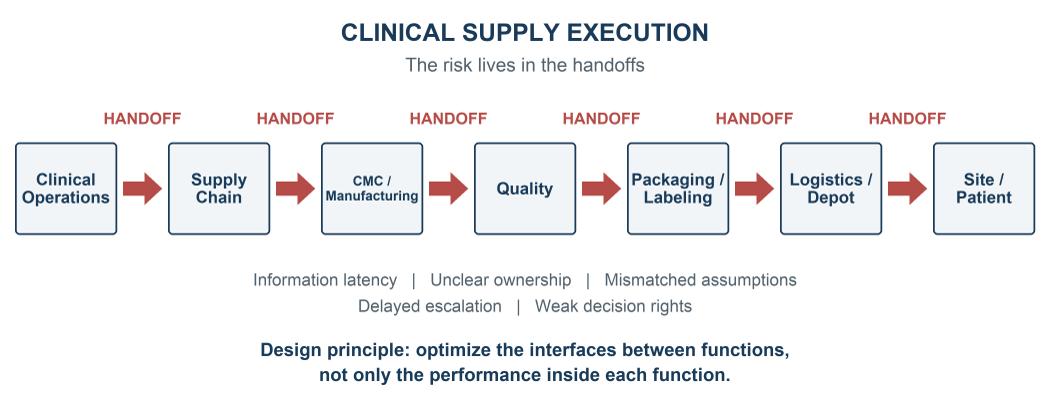
Figure 1. Clinical supply risk often concentrates at functional interfaces.
Clinical supply organizations spend enormous energy improving individual capabilities: forecasting, supplier qualification, manufacturing planning, inventory control, packaging, labeling, distribution, and digital visibility. Yet disruptions still occur in programs where every function appears to be doing its job.
A batch can be manufactured on schedule but released too late to support packaging. Inventory can be healthy globally while a fast-enrolling country approaches a stockout. A site can activate earlier than expected while its initial shipment remains in an import process. Quality can be investigating a deviation without realizing that the affected lot represents the program’s last viable supply buffer.
These are not always failures inside a function. They are failures at the handoff: the moment ownership, information, timing, assumptions, or decision rights move from one part of the clinical development system to another.
That distinction changes the improvement agenda. Clinical supply organizations are usually designed to manage boxes on an organization chart. Clinical trials, however, are executed through arrows: flows of information, material, decisions, and patients. We have become good at optimizing the boxes. The next opportunity is to fix the arrows.
Clinical Supply Is A System Of Handoffs
Consider what must happen before a single dose reaches a patient. A protocol creates a demand requirement. Clinical Operations converts the protocol into enrollment expectations. Supply Chain translates enrollment into demand and inventory requirements. CMC and Manufacturing convert those requirements into production plans. Quality determines when manufactured material becomes usable. Packaging and labeling make released material protocol- and country-appropriate. Logistics and depots position it. IRT allocates it. The site ultimately dispenses it.
Every transition creates a point where information can arrive late, assumptions can diverge, accountability can blur, or an exception can wait too long for a decision. Competent teams, qualified vendors, and adequate inventory are necessary, but they do not guarantee a reliable system if the interfaces between them are weak.
Handoff 1: Clinical Operations To Supply Chain
Enrollment is the first major source of volatility. Site activation shifts, screening rates change, countries recruit at different speeds, cohorts expand, and protocol amendments alter demand. A forecast can remain mathematically correct against its original assumptions while becoming operationally obsolete.
The real issue is often not forecast accuracy; it is information latency. Clinical Operations may already know that three high-performing sites have activated and screening has accelerated, while Supply Chain is still planning against the previous monthly forecast.
The better question is not simply, “What is our forecast?” It is, “What changed since the forecast was approved?” Leading indicators, including site activation, screening velocity, screen failures, randomization, dropout, cohort expansion, and dosing changes, should continuously inform supply risk.

Handoff 2: Supply Planning To Manufacturing
A demand plan does not create supply. Manufacturing slots, materials, testing, disposition, packaging, and distribution must align with the date patients actually need product. This is where a deceptively reassuring statement often appears: “The batch will be manufactured in October.”
Manufacturing completion is not the same as patient availability. A batch completed in October may still require testing, quality review, release, packaging, labeling, and distribution. Clinical supply plans should therefore manage a dose-ready date: Manufacturing → Testing → Quality Release → Packaging/Labeling → Distribution → Available for Patient.
Changing the milestone from “batch complete” to “deployable inventory available” forces functions to plan against the same clinical outcome.
Handoff 3: Manufacturing To Quality
This handoff exposes one of the most important distinctions in clinical supply: physical inventory is not deployable inventory. Material awaiting testing, disposition, deviation closure, stability confirmation, or another release activity cannot yet be used to dose a patient.
A useful operating equation is simple: Deployable Inventory = Physical Inventory − Restricted Inventory. Restricted inventory may include quarantined or expired product, stock under investigation, country-incompatible labels, protocol-incompatible material, or inventory committed elsewhere.
The same quality event can also carry very different meaning across functions. To Quality, it may be one investigation among several. To Supply Chain, the affected lot may represent the difference between six months of coverage and six weeks. The handoff must therefore communicate patient and program impact, not only investigation status.

Handoff 4: Global Inventory To Country Availability
Aggregate inventory can create false confidence. Twelve months of global supply does not prevent a stockout in one country. Labels, protocol versions, shelf life, depot location, import constraints, and regulatory requirements determine whether inventory is actually interchangeable.
This is why clinical supply leaders should increasingly communicate inventory in patient terms. “We have 5,000 kits” is descriptive. “We can support approximately 87 patients under the base case, but Country X has less than six weeks of coverage if current enrollment persists” creates a decision.
Scenario planning makes that decision stronger. P50 can represent expected demand, P80 an operational planning case, and P95 a high-demand risk case. The objective is not to pretend that one scenario predicts the future; it is to understand whether the supply strategy can withstand several plausible futures.

Handoff 5: Depot To Site, And Site To Patient
Product can be released, packaged, and sitting in a depot, and the patient can still miss a dose. Site inventory may be misaligned with recruitment. Resupply settings may lag behind actual enrollment. Customs delays, courier problems, or temperature excursions can interrupt the final movement.
Traditional supply chains often use OTIF (on time, in full). Clinical supply should translate that concept into a clinical outcome: Dose In-Full, On-Time. A shipment can meet a logistics metric and still put the trial at risk if the correct treatment is unavailable when the patient needs it.

The Hidden Handoff: Data To Decision
Enrollment may live in CTMS, randomization and site inventory in IRT, manufacturing schedules in partner files, quality events in a QMS, depot stock in warehouse systems, shipments with couriers, and financial exposure elsewhere. The problem is often not a lack of data. It is a lack of decision-ready information.
“Inventory: 3,850 units” is information. “Country A reaches its P95 stockout threshold in 47 days” is decision support. “Batch 004 release delayed” is information. “Batch 004’s delay reduces patient coverage below the next replenishment cycle” is decision support.
A clinical supply control tower should therefore be an exception-management system, not a wall of KPIs. Its purpose is to shorten the time between signal and action. Leaders should be able to see patient coverage, time to stockout, deployable inventory, release risk, expiry exposure, country-level constraints, critical supplier vulnerabilities, lane risk, unresolved actions, and potential supply-driven patient delays at a glance.
From Forecast Accuracy To Patient Coverage Probability
Clinical demand contains uncertainty that better forecasting alone cannot eliminate. A more useful executive question is: What is the probability that sufficient released, usable, correctly positioned supply will be available when a patient requires treatment?
Call this Patient Coverage Probability. It shifts the conversation from whether the forecast was “right” to whether the supply strategy is robust. It also forces manufacturing, quality, inventory, country availability, and logistics into the same calculation, rather than allowing each function to report success independently.
Clinical S&OP Must Become A Decision Forum
A Clinical Supply & Operations Planning process should connect Clinical Operations, CMC/Manufacturing, Supply Chain, Quality, Regulatory, and Finance around one set of assumptions. Clinical Operations updates enrollment. Manufacturing updates capacity and timing. Quality updates release risk. Supply Chain models scenarios and coverage. Regulatory identifies country constraints. Finance quantifies economic exposure.
Then the group makes decisions: add a manufacturing campaign, build buffer stock, qualify redundancy, reposition depot inventory, initiate a labeling campaign, expedite a shipment, or accept a quantified risk. A cross-functional meeting in which every department presents slides is not integrated planning. Integration occurs when functions make a shared decision and understand its downstream consequences.
Measure The Cost Of Risk, Not Just The Cost Of Supply
Supply leaders should control manufacturing, inventory, storage, and logistics costs. But optimizing those costs without considering program risk can produce the wrong answer. An additional manufacturing campaign may look expensive until its cost is compared with the risk-adjusted value of avoiding a three-month clinical delay.
The same logic applies to dual sourcing, extra inventory, redundant lanes, backup packaging capacity, and other resilience investments. The relevant equation is not simply supply cost. It is risk-adjusted clinical supply cost: execution cost plus the expected impact of failure.
This gives clinical supply leaders a stronger language for executive and CFO discussions. Resilience stops looking like unnecessary redundancy and becomes an investment against quantified program exposure.
Fix The Arrows, Not Just The Boxes
Technology will continue to improve forecasting, visibility, manufacturing planning, logistics, and analytics. Those investments matter. But technology alone will not eliminate the handoff problem.
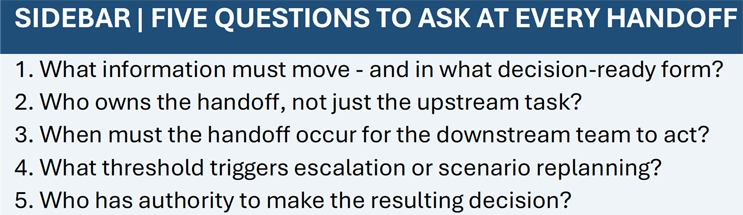
The deeper solution is to design the interfaces deliberately. Enrollment changes should trigger supply signals. Supply changes should update manufacturing decisions. Manufacturing and quality events should immediately recalculate patient coverage. Country inventory changes should trigger repositioning. Logistics exceptions should expose patient consequences. Every signal should arrive with an owner, threshold, decision right, and time expectation.
Ultimately, clinical supply performance should converge on one question: Can we dose the next patient on time, with the right product, at the right location, without compromising quality?
Then the harder questions follow: Can we still do it if enrollment accelerates? If a batch is delayed? If a supplier fails? If a shipment is lost? If our assumptions are wrong?
Clinical supply excellence is not achieved when every function performs its own work perfectly. It is achieved when the whole system continues to deliver despite uncertainty. The next frontier of clinical supply optimization may therefore not be inside our processes at all. It may be in the spaces between them.
About The Author:
 Rakibou Ouro-Djobo is a clinical supply and logistics leader focused on building resilient, patient-centered supply models for clinical development. Through OuroLynx, he advises life sciences organizations, providing strategic and execution consulting to strengthen supply resilience, cross-functional coordination, and patient access to treatment. This article reflects the author’s professional perspective; the mini-cases are anonymized composites intended to illustrate operating principles.