
The Hidden Cost Of The "Cheap" Comparator Drug: Why The Lowest Price Can Become The Most Expensive Choice In Clinical Trials
By Khaled El-Gendy, Founder, KEG Pharma LLC

In clinical trial supply, comparator sourcing often begins with what appears to be a straightforward commercial question: How much does the product cost per unit?
When several suppliers offer the same comparator, the quotation with the lowest unit price naturally attracts attention. For high-value medicines, even a relatively small percentage difference can translate into hundreds of thousands of dollars in apparent savings.
But the purchase price tells only part of the story.
A comparator costing $900 per unit can ultimately prove considerably more expensive than one costing $1,000. Shelf life, documentation, traceability, source market, packaging configuration, logistics, supply continuity, wastage, and emergency resupply can all transform an attractive quotation into a costly operational problem.
More importantly, comparator supply failure can affect something far more valuable than the drug budget: the clinical trial timeline itself. The right question is therefore not: “What is the cheapest price per unit?” It is: “What is the total cost and risk of providing compliant, usable comparator to the trial when and where it is required?”
Purchase Price Is Only The Visible Cost
A commercially available medicine does not become suitable clinical trial supply simply because it has been purchased. Between sourcing and administration to a patient, there are multiple activities involving procurement, quality, regulatory, clinical supply, logistics, packaging, depots, and clinical sites. Consequently, comparator economics should be viewed through a broader equation:
True Comparator Cost = Acquisition Cost + Supply-Chain Cost + Quality and Regulatory Cost + Operational Cost + Risk-Adjusted Cost of Supply Failure
The first component is highly visible. The others are often less visible when suppliers are initially compared. This can lead organizations to optimize the smallest and easiest to measure number while unintentionally increasing the overall cost of the trial.
Shelf Life: A Cheap Unit That Cannot Be Used Is Expensive
Remaining shelf life should be considered an economic variable, not simply a product specification.
Suppose a trial requires comparator over 18 months. One supplier offers stock with substantial remaining shelf life, while another offers a lower price for stock expiring considerably earlier.
The cheaper stock may require another procurement exercise before the trial ends. Existing inventory could expire at depots or sites, while replacement stock may require additional quality review, packaging, labeling and distribution.
The true metric is therefore not simply cost per unit purchased, but cost per usable unit throughout the required supply period. A $900 unit that expires before it can be used has not saved $100. It may have wasted $900 and created the requirement to purchase another unit.
Documentation, Traceability, And Quality
Clinical trial comparator sourcing requires confidence in the product and its supply chain. Depending on the product, market, and study requirements, teams may need appropriate documentation relating to product origin, batch information, storage and transportation history, authenticity, and traceability.
A cheaper source accompanied by documentation gaps can create substantial hidden internal costs. Procurement may spend time pursuing documents. Quality teams may need additional assessments. Clinical supply personnel may investigate alternative solutions. Packaging activities may be placed on hold while questions are resolved. These costs rarely appear in the supplier quotation. Yet highly qualified employees spending days resolving a preventable sourcing problem represent a genuine cost to the organization.
More importantly, documentation problems can consume something that cannot easily be purchased back: time.
The Same Drug Does Not Always Mean The Same Supply Solution
Comparator medicines sourced from different countries may contain the same active substance, strength, and dosage form but still present different operational characteristics. Pack size, language, commercial presentation, labeling, serialization or identification features, device configuration, and other market-specific elements may differ. The lowest-priced market is therefore not automatically the most appropriate sourcing market. An attractive unit price can be offset by additional packaging and labeling complexity, operational handling, or regulatory and quality considerations. Comparator sourcing should consequently be a cross-functional decision rather than an isolated purchasing transaction.
Logistics Can Change The Economics
For temperature-sensitive products, particularly expensive biologics, transportation strategy can significantly influence the true cost of supply.
A quotation may exclude specialized transportation, temperature monitoring, customs handling, insurance, or storage. Another supplier may incorporate these activities into a higher initial price. The first quotation looks cheaper because some of the costs have simply been moved elsewhere.
The greater concern is what happens when something goes wrong. A temperature excursion involving 100 comparator units valued at approximately $1,000 each potentially places $100,000 of product at risk before considering investigation, replacement transportation, and operational delays.
For expensive comparator medicines, supply chain reliability therefore has measurable financial value.
Continuity Of Supply Has A Price — And A Value
Clinical trial demand rarely follows forecasts perfectly. Recruitment may accelerate. Additional patients or countries may be added. Treatment duration may change. Wastage may exceed assumptions. A supplier offering 1,000 units today at an excellent price may therefore be less valuable if it cannot provide another 300 units six months later.
Emergency sourcing can require different suppliers or source markets, expedited freight, and additional packaging and quality activities. The initial sourcing decision should therefore evaluate not only “Can the supplier deliver now?” but also “What happens if we need more?”

When An Apparent $100,000 Saving Becomes A Loss
Consider a hypothetical trial requiring 1,000 units of comparator.
The expected benchmark price is approximately $1,000 per unit.
Supplier A offers 1,000 units at $1,000 each.
Initial acquisition cost: $1,000,000
Supplier A can provide suitable remaining shelf life, appropriate documentation, and a reasonable expectation of continuity of supply.
Supplier B, however, identifies stock at only $900 per unit.
Initial acquisition cost: $900,000
On a conventional procurement comparison, Supplier B has generated an impressive $100,000 saving.
The purchasing decision appears obvious.
But assume Supplier B's stock has shorter remaining shelf life, documentation requires additional investigation, and the trial subsequently needs replacement stock. Additional packaging activities and urgent international shipments are required.
The final economics might look like this:
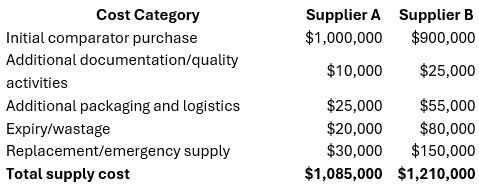
Figures are hypothetical and provided solely to illustrate the total-cost principle.
The supplier that appeared to save $100,000 has ultimately cost the trial $125,000 more.
In other words, focusing on unit price alone changed what appeared to be a $100,000 saving into a $125,000 additional cost — a $225,000 swing against the original procurement expectation. And even this calculation excludes perhaps the greatest financial exposure of all: a delay to the clinical trial.
The Most Expensive Comparator May Be The One That Arrives Too Late
If comparator problems delay packaging, site activation, patient randomization, or dosing, the financial consequences move beyond the clinical supply budget.
Sites, CROs, depots, and internal study teams continue to generate costs. Packaging schedules may need to be rearranged. Recruitment can be disrupted. Investigators and patients may be affected.
For a strategically important clinical development program, the commercial impact of delay may dwarf the amount originally saved on comparator procurement. This is why supply security has economic value, even though it rarely appears as a separate line on a quotation.
Moving From Unit Price To Total Cost And Risk
None of this means that sponsors should ignore comparator prices or routinely select more expensive suppliers. Competitive sourcing remains essential.
The issue is what is being compared. A robust sourcing decision should evaluate at least:
- Acquisition price and total quantity required
- Remaining shelf life
- Confirmed availability
- Source market and pack configuration
- Supplier qualification and supply chain traceability
- Documentation availability
- Transportation and temperature requirements
- Packaging and labeling implications
- Import/export complexity
- Potential wastage
- Ability to provide additional quantities
- Replacement lead time
- Risk and potential cost of supply interruption
A comparator priced 5%–10% higher may represent significantly better economic value if it reduces expiry, documentation problems, emergency procurement, and the probability of disrupting the study.
Procurement And Clinical Supply Need The Same Definition Of “Saving”
The challenge is not that procurement professionals focus on cost. Cost control is essential, particularly when comparator expenditure can represent millions of dollars. The challenge arises when purchase price saving and total cost saving are treated as the same thing. They are not. Procurement, clinical supply, quality, and regulatory teams should therefore share a broader definition of value.
A successful comparator sourcing decision is not necessarily one that achieves the greatest discount against the initial benchmark. It is one that delivers the required quantity, quality, documentation, shelf life, and continuity at the lowest reasonable total cost and risk to the trial.
Supplier performance should be assessed in the same way. The strongest comparator sourcing partner is not simply the organization capable of finding the cheapest commercial stock. Value also comes from identifying an appropriate source market, understanding trial requirements, anticipating documentation and shelf-life issues, securing continuity, and developing contingency options before they become emergencies.
The Question We Should Be Asking
When the next comparator quotations arrive, the decision should not begin and end with: “Who has the lowest unit price?”
A better question is: “Which sourcing option provides the lowest total cost while protecting the continuity and timeline of the clinical trial?”
The price on the quotation is visible. The costs of expiry, wastage, additional quality work, emergency shipments, replacement sourcing, and supply interruption are much less visible. But those costs are real.
For a comparator costing approximately $1,000 per unit, seemingly small sourcing decisions can rapidly create six-figure financial consequences. The objective of comparator sourcing should therefore never be simply to purchase the cheapest unit. It should be to secure the most cost-effective, compliant, and reliable supply solution for the life of the clinical trial, because in clinical trial supply, the lowest-priced comparator can sometimes become the most expensive comparator of all.
About The Author:
 Khaled El-Gendy is a senior pharmaceutical and clinical trials executive with more than 25 years of international experience across clinical supply chain, comparator drug sourcing, and strategic business development. He has supported biotech, pharmaceutical, and service organizations in navigating complex global markets, securing critical trial supplies, and building high-value commercial partnerships. He is the founder of KEG Pharma LLC, a Spain-based advisory firm focused on life sciences, market access, and growth strategy.