
When Clinical Supply Data Disagrees: Who Owns The Decision?
By Edwige Njayap Nouboug, BioPharma Deputy Lead, consultant at Sanofi

Before assigning ownership of any decision, we need to understand where each piece of data comes from, how it travels, and what it was designed to represent. Global clinical development brings together multiple ecosystems, each with its own purpose, governance, and way of interpreting reality. Their data may appear to conflict because those systems are answering different questions or operating on different timelines.
The goal is to bring those signals into a clear, shared view of the situation while preserving the origin, meaning, traceability, and ownership of each one. That shared understanding allows the accountable people to make informed decisions — and explain why they made them.
When Clinical Supply Data Disagrees: What Is Each System Really Telling Us?
When clinical trial data tell different stories, the first instinct is often to look for a faulty system or a human mistake. The explanation is less straightforward. The beginning of the answer starts with the interconnected system architecture to be explained. The strategic planning tier, enterprise governance tier, and execution and fulfillment tier serve different purposes. They capture different details, built with divergent operational objectives, differing data structures, asynchronous interface frequencies, and conflicting semantic definitions.
1. Strategic Planning Tier: Often associated with the predictive forecasting engine, this looks ahead.
They aim to model patient enrollment and simulate future kit demand and packaging campaign schedules. It acts as an advisory and modeling layer that pushes demand signals down to both enterprise governance systems and operational clinical systems. It sends those demand signals to the teams and systems that need to prepare.
2. Enterprise Governance Tier: Often associated with the enterprise ERP and the clinical trial management system (CTMS).
They aim to track legal and financial ownership, raw material ownerships, and batch disposition when applicable. Together, they help to understand whether the supplies and the sites are ready to move forward.
3. Execution and Fulfillment Tier: Often associated with the depot warehouse management system (WMS) and the RTSM/IRT.
They aim to track what is happening day to day in order to see where supplies are and how they are being used.
When Clinical Supply Data Disagrees: Where Does The Picture Break Down?
The architecture tells us what each system is meant to know. It does not tell us whether that knowledge is current, whether a status means the same thing everywhere, or whether an event on the ground has been recorded at all. Four recurring situations turn those differences into decisions that cannot wait.
- Interface Latency and Asynchronous Sync Pipelines:
This is a common case where a decision has been made, but the update has not arrived. This situation can happen when a qualified person signs an electronic release certificate extending a lot's expiration date in an enterprise QMS/ERP. That status must propagate through middleware layers to the IRT and 3PL WMS platforms. This shelf-life extension may be approved in the quality system while the IRT still treats the kits as nearing expiry. Until the change reaches every relevant platform and is verified, teams can see conflicting statuses for the same stock.
- Semantic Divergence of Status Definitions:
The same word can describe different conditions. Can you be sure that when you mention the term "available" this carries the same meaning across the system?
ERP will consider that the batch is financially cleared and released by quality; depot WMS could indicate physical presence on a pick-face rack; RTSM/IRT will probably consider an undamaged, non-quarantined, non-allocated kit physically received, acknowledged by site staff, and within valid shelf-life limits for the scheduled patient visit window.

- Uncaptured Physical Reality:
This means something has happened that no system yet reflects. Physical anomalies occurring on the ground, such as a temperature excursion during last-mile courier transport, physical breakage during unboxing, or unrecorded kit quarantine by site pharmacists, create immediate operational divergence. The IRT may still flag the kit as available on site while the site staff has isolated the kit in a physical quarantine locker.
- Velocity Mismatches (Planned vs. Actual Demand):
This schema happens when actual demand has moved away from the plan. The plan stops matching the real activity at the site. If a specific investigative site experiences high screening failure rates, the CTMS registers high screening activity while the IRT registers zero dispensations, pushing supply orders into the ERP, creating severe overstocking and impending expiry write-offs at the depot.
When Clinical Supply Data Disagrees: Clear Governance Owns Decisions Over Data
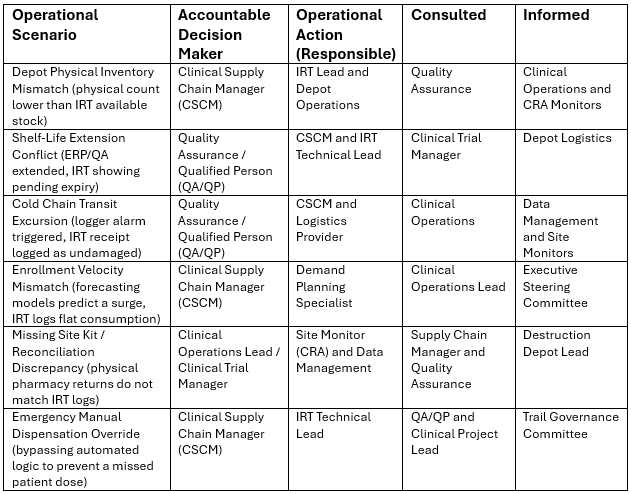
Systems can be trusted to identify surface discrepancies, but humans will always be necessary to arbitrate them. We saw that systems are complex and will encounter points of frictions because transport networks experience disruptions, software interfaces encounter latency, and physical inventory occasionally goes missing. What is visible becomes organizational ambiguity. Getting resilient helps avoid wasting time debating who is at fault. While software provides visibility, only an institutionalized governance model could assume a direction. Eliminating gray zones can be measured by establishing absolute domain authority leadership — anchoring patient safety to the IRT, batch release to the QMS, and accountability to a pre-approved RACI matrix. So, when clinical supply data disagrees, technology merely provides the evidence, but clear, predefined governance must own the decision.
Key Operational Scenarios And Decision Rights
The Next Frontier Will Occur From Fragmented Signals To Coordinated Actions
Establishing clear governance resolves immediate operational friction, but what about the ultimate evolution of clinical supply management that lies in preventing data divergence entirely?
The next frontier shifts the industry from managing fragmented operational signals to orchestrating fully coordinated actions.
To succeed in this transformation, organizations’ supply infrastructures will have to be built around four core technological pillars: real-time event-driven architecture, ontological data standardization, clinical supply control tower, and, obviously, connected predictive simulation.
An upcoming article will examine how to build a networked clinical supply operating model to hasten organizations’ transitions from manual reconciliation to a fully automated predictive control tower.
About The Author:
 Edwige Njiayap Nouboug is a biopharma deputy lead and consultant at Sanofi with 15 years of experience in digital transformation, data governance, and user adoption across regulated industries, with a focus on life sciences.
Throughout their career, they have led global initiatives at organizations including Roche and Pierre Fabre, driving improved decision-making, operational excellence, and the successful adoption of digital platforms such as CRM and data governance systems in complex, highly regulated environments.
Passionate about translating complexity into practical business outcomes, Edwige shares insights through the newsletter From Clarity to Execution and writes regularly on digital transformation, governance, and leadership in the life sciences industry.