
Where Comparator Decisions Are Written Down
By Hedley Rees
The EU and US systems record comparator decisions in different places, but both separate the description of the product from the description of how participants receive it.
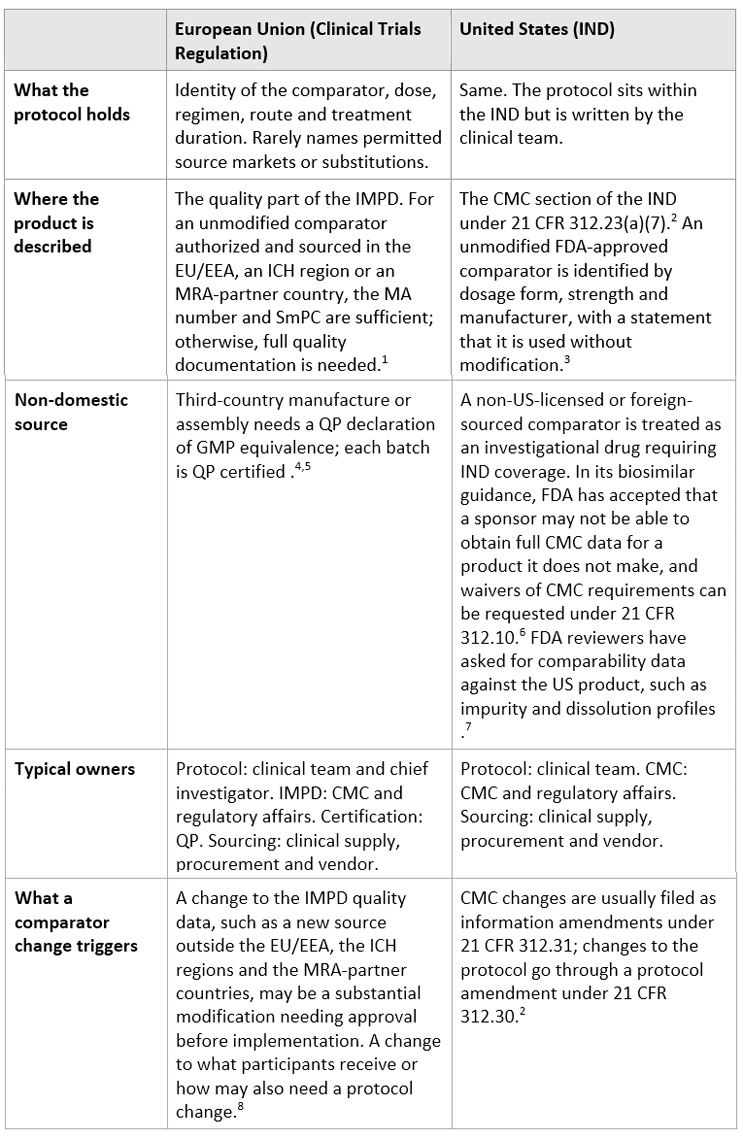
The point of the table is not the detail. It is that, in both systems, the documents that describe the comparator (the IMPD and the IND CMC section) are prepared by different teams, on different timelines, from the document that describes what happens to participants (the protocol). A change of source is handled mainly in the CMC documentation. Whether that change matters for participants depends on the protocol, and the protocol usually says nothing about it.
Why Sourcing And Clinical Decisions Get Separated
The separation is not a failing of any individual. It is built into the way the work is organized. Four features of that organization do most of the damage.
Different timelines. Comparator sourcing for a large study often has to start before the protocol is final, because lead times for high-volume or restricted products are long. The opposite also happens: the protocol is signed off and sourcing is then treated as an execution task. Either way, the sourcing contract and the protocol are not finalized together, and the questions that link them are not asked at either point.
How procurement performance is measured. Comparator procurement is usually judged on cost per pack, on-time delivery, documentation completeness and the absence of site stock-outs. These are sensible measures. None of them asks whether a participant stayed on the same version of the comparator throughout treatment, or whether a change was approved by a clinician. What gets measured gets managed, and continuity of the control arm is rarely measured.
Layers of outsourcing. A typical chain runs from sponsor to CRO, to comparator sourcing vendor, to one or more wholesalers, to a CDMO for blinding and packaging, and then to a depot. Each link has its own contract with the next, and each contract is written around the deliverable of that link. Nobody in the chain is contracted to hold the overall picture of what is happening to the control arm, except the sponsor, and the sponsor has often outsourced the people who would notice.
Different owners of different documents. Clinical owns the protocol, CMC and regulatory own the IMPD or IND quality sections, the QP owns certification and clinical supply owns the purchase. Each document is correct on its own terms. The gap is between them.
My long-standing argument about pharmaceutical supply chains is that the structure produces the outcome. If the people who buy the comparator are measured on cost and continuity of supply, and the people responsible for participants are not involved in buying it, then decisions with clinical consequences will be made on commercial grounds. That is not a question of competence. It is how the system was designed.
Part 1 of this series showed how a sourcing change can arise from ordinary commercial pressures. Part 3 examines what that change can mean for participants and how clinical oversight can be built into the sourcing process before a change is needed.
References:
- EMA, Guideline on the Requirements for the Chemical and Pharmaceutical Quality Documentation Concerning Investigational Medicinal Products in Clinical Trials. https://www.ema.europa.eu/en/documents/scientific-guideline/guideline-requirements-chemical-and-pharmaceutical-quality-documentation-concerning-investigational-medicinal-products-clinical-trials-revision-1_en.pdf
- Electronic Code of Federal Regulations, 21 CFR 312.23 and the relevant IND amendment provisions, including 21 CFR 312.30 and 312.31. https://www.ecfr.gov/current/title-21/chapter-I/subchapter-D/part-312/subpart-B/section-312.23
- FDA, CMC Topic: Active Control. https://www.accessdata.fda.gov/cder/cmc/topic7/topic7/da_01_07_0010.htm
- MHRA Inspectorate, Annex 16 QP Certification and Batch Release: Frequently Asked Questions, Part 2. https://mhrainspectorate.blog.gov.uk/2017/08/14/annex-16-qp-certification-and-batch-release-frequently-asked-questions-part-2/
- Commission Delegated Regulation (EU) 2017/1569. https://eur-lex.europa.eu/eli/reg_del/2017/1569/oj
- FDA, New and Revised Draft Q&As on Biosimilar Development and the BPCI Act. https://www.fda.gov/media/119278/download
- FDA, Quality Issues for Clinical Trial Materials: CMC and the Investigator’s Brochure. https://fda.report/media/87444/1-00---1-30-CMC-and-the-investigator-Brochure-%2528Drugs%2529---Ensuring-the-Quality-of-a-Drug-used-in-a-Clinical-Trial.pdf
- MHRA, Common Issues Identified During Clinical Trial Applications: Pharmaceutical. https://www.gov.uk/government/publications/common-issues-identified-during-clinical-trial-applications
- EMA, Guideline on the Requirements for Quality Documentation Concerning Biological Investigational Medicinal Products in Clinical Trials. https://www.gov.uk/government/publications/common-issues-identified-during-clinical-trial-applications/common-issues-pharmaceutical
About The Author:

Hedley partners with pharma and biotech leaders, investors, and policymakers who recognize that today’s fragmented supply chains, outsourcing dependencies, and opaque practices are no longer fit for purpose. Working across nonclinical, clinical, and commercial stages, Hedley helps organizations redesign end‑to‑end supply networks, rethink CDMO strategies, and build operational models that are resilient, data‑driven, and accountable to patients and society.
His work shines a light on hidden risks, perverse incentives, and gaps between regulatory intent and industry behavior. As an outspoken commentator and advocate for change, Hedley contributes to public and boardroom debates on drug shortages, reshoring, vertical integration, and regulatory reform.
He is the author of Transforming the Pharmaceutical Supply Chain (Wiley, 2025) and Supply Chain Management in the Drug Industry: Delivering Patient Value for Pharmaceuticals and Biologics (Wiley, 2011).