
Los Angeles And Long Beach Port Strike Deadline Moves To Nov. 20, Keeping Ocean Freight Risk In Play
By Elizabeth Urbanek, Executive Editor
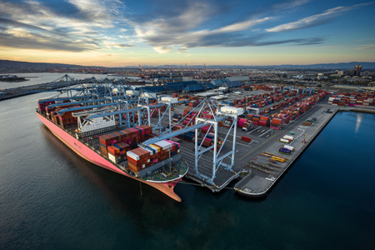
The security watchmen at the ports of Los Angeles and Long Beach won't strike before Nov. 20. Their union and the employers' association agreed to extend the contract another two weeks, the third extension since the first strike deadline on Nov. 1.
The Pacific Maritime Association (PMA), which represents terminal operators and shipping lines at West Coast ports, announced the extension Nov. 6. It said more bargaining sessions with International Longshore and Warehouse Union (ILWU) Local 26 are scheduled before the new deadline.
Local 26 is small. It represents about 250 watchmen who handle security at six container terminals. But PMA says those terminals move roughly 85% of the cargo through Long Beach and 33% through Los Angeles. PMA has also said dockworkers and marine clerks, who work under their own contract, aren't expected to cross a picket line. A walkout could halt vessel, yard, and gate operations at those terminals.
The union authorized a strike in late October with a Nov. 1 deadline. That date slid to Nov. 4, then to midnight Pacific time on Nov. 6. Federal mediators are involved, and the previous contract expired in July 2025.
As of publication on Nov. 10, neither side had announced an agreement, and no strike had begun. PMA hasn't said how close the two sides are or what happens if Nov. 20 passes without a deal. Its statement doesn't mention pharmaceutical or temperature-controlled cargo.
What This Means For Clinical Supply
Most investigational medicinal products (IMPs) fly, so a strike at two seaports wouldn't stop the bulk of clinical trial shipments. The risk is in what travels by sea: ancillary supplies, devices and kits, packaging components, bulk comparator purchases, and other materials that sponsors and vendors ship by ocean to keep costs down. If any of it moves in refrigerated containers, a delay at the terminal becomes a temperature problem, too.
Timing is what makes this hard to manage. The deadline has moved three times in about a week, and a container already on the water is far harder to redirect than one that hasn't loaded. Teams can see the risk coming without having much room to act on it.
Rerouting has its own costs. Shifting shipments to air or to another port adds expense, and a new temperature-controlled lane may need qualification work before it can be used. Staying the course saves that money but leaves inbound materials exposed if talks fall apart.
No single team has the full picture. Procurement and freight forwarders know where containers are booked. Depot operations knows how much buffer stock sits downstream. Study teams know which shipments gate a site activation or a resupply wave. Those answers need to come together before Nov. 20, not after.
A practical first step is to ask forwarders which terminal each inbound container is booked to, flag anything critical moving through the affected terminals in the next few weeks, and agree in advance on what would trigger a switch to a backup route.
What no one can say yet is whether a strike will happen, how long it would last, or how quickly terminals would recover. PMA's statement doesn't address any of that, so any estimate of the impact on clinical supply would be guesswork for now.
For sponsors with freight moving through Southern California, the real question is whether paying for a backup plan now costs less than learning on Nov. 21 that critical materials are sitting at a closed terminal.
The Supply Question
How early should clinical supply teams decide to reroute shipments when a port disruption is possible but not certain?
Related Clinical Supply Leader Editorials:
- Clinical Trial Supply Chains Need To Prepare For A Less Predictable World
- What Your Tier 1 Supplier Map Might Be Missing
- Sourcing Through The Tariff Mess: What 2026 Actually Means For Clinical Supply
About The Editor:
 Elizabeth Urbanek is the Executive Editor for Clinical Supply Leader, where she works with clinical trial supply and logistics professionals across pharma and biotech to bring real-world perspectives, operational challenges, trends, scientific insights and regulatory strategy to the field.
Before joining life sciences media, Elizabeth spent more than 15 years in broadcast, digital and live-event storytelling, helping highly technical teams communicate complex ideas with clarity and impact. She brings that same approach to clinical supply, creating editorial space for experts to share what is happening across clinical trial operations.
Elizabeth is passionate about connecting people and ideas, identifying emerging themes and showcasing work that can move the clinical supply field forward.